Showing posts with label Books. Show all posts

Friday, February 19, 2010

Destroyermen: Into the Storm - Review

Audible.com had a $4.95 sale on the first book of several series, one of which was Into the Storm: Destroyermen, Book I by Taylor Anderson, an Alternative History novel in which a WWI vintage destroyer, out of date and running from the Japanese in the early days of the WWII Pacific theater, gets sucked into an alternative world which is physically the same as the one they left, but on which different life forms have evolved.
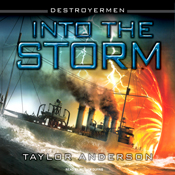

While interesting, what really caught my eye, from the publisher's description was that, on this version of earth, two different intelligences had evolved and are at war, the humans "have the means to turn a primitive war into a genocidal Armageddon, one thing becomes clear: They must decide whose side they're on. Because whoever they choose to side with is the winner."

The book is solidly, if unexceptionally, written. As the destroyer is part of a fleet that is trying to escape the Japanese, a chance is had for the ship to pick up some additional people, besides the crew. There are a couple of pilots (gotta be able to fly on the alternate world), some nurses (gotta have some women), and an Australian jack-of-all-trades scientist (who can be knowledgeable and/or ignorant, as needed.) They even rescue a Japanese sailor who got sucked through the squall into this world along with them. A Japanese sailor on a US Navy ship, now that's conflict! (Fortunately, he was educated in the US, speaks English, and wasn't too gung-ho about the Pearl Harbor attack. Wouldn't want to have to actually deal with conflicting viewpoints.) While these are fairly formulaic, they are not hard to swallow in the context of making the cast of characters more interesting, and creating some potential plot conflicts.

The battle descriptions are very good. The ship's abilities are discussed, and the battle tactics are described, well, but without so much jargon that it becomes incomprehensible. The captain, whose viewpoint rightly dominates the book, is a reasonably interesting character. Most of the other characters are right out of central casting.

My problems with the books start to appear as the crew meets the first alien (to them) race, one descended from lemurs. I was looking forward to the ethical dilemma of choosing sides, but this dilemma disappears almost immediately, as these nice furry people are under attack by a race descended from raptors, who have no redeeming social qualities, and also have big teeth. While a paragraph or two is spent on the captain hemming and hawing over stepping in, he quickly decides to help the beleaguered "cat-monkeys" and the dilemma is over before it has a chance to begin.

I was also annoyed by the fact that this alternate world was supposed to be as old as the earth, and yet the races on it are far behind humans in technology. No explanation is given as to why they are so far behind, it just makes for a better story.

The book moves along well enough that until it is an enjoyable read/listen, but afterward I realized that it was mostly a waste.

Tuesday, February 16, 2010

Possibly the best part of the new Holmes movie

The kids and I the new Robert Downey Jr. Sherlock Holmes movie at Christmas, and it was fun. Not great, but a lot of fun. RDJ was quite unconvincing as Holmes, but Jude Law was an excellent Watson, the sets were wonderful, and the movie was a lot of fun. But this post isn't about the movie.

One of the side effects of the studio pumping millions into promoting "Sherlock Holmes" is that a number of other products piggybacked on that advertising.

The Sherlock Holmes Collection is a collection of episodes from a 60's series that I had not heard of before. It stars Peter Cushing, who was a very respectable Holmes in Hammer Films' Hound of the Baskervilles, and does a very good job here also. Nigel Stock is a bit old for Watson (the influence of the Nigel Bruce portrayal, one supposes) but handles the character well.

Another excellent BBC series that was released this fall was The Rivals of Sherlock Holmes: Set 1 (Set 2 will be available in April). This early 70's series presents stories based on stories of other contemporary detectives, such as Martin Hewitt, Max Carrados and Dr. Thorndyke, and has a number of actors that we saw much more of later, such as Derek Jacobi, Jeremy Irons and John Neville. For a mystery fan like me, this is a gold mine!

For a nice range of Holmes movies at a reasonable price, The Sherlock Holmes Collection has three solid movies, the Hammer Hound of the Baskervilles, the excellent, Billy Wilder directed Private Life of Sherlock Holmes, and the hilarious Without a Clue with Michael Caine and Ben Kingsley.

TCM showed the restored version of the 1922 silent Sherlock Holmes, based on the William Gillette play, and this version should be available soon for hardcore Sherlockians like me.

With the Holmes books in the public domain, Barnes & Noble and Amazon have new editions available for a reasonable price, including several versions for the Kindle. My favorite new edition of a Holmes book has to be Hard Case Crime's version of The Valley of Fear (cover shot below) which it lists as by "A. C. Doyle", and is "Based on a True Story", which is true, if a bit stretched. I am pretty sure that I don't remember "The Bodymaster" my previous readings of the novel. (You have to love the subtle placement of the "V"!)

Monday, January 19, 2009

Happy Birthday, Poe

Two hundred years ago today, a child was born who would, in the course of a too short and over troubled life, help spawn the detective story and the science fiction story. One of his stories would generate public interest in cryptography and cryptograms, another would inspire a sequel by Jules Verne. Amazingly enough, these are not what Edgar Allan Poe is best remembered for today.

The macabre was Poe's best remembered milieu. The Raven, an ode to a love lost to death, is Poe's best remembered work and has an football team named in its honor and has inspired a song:


a Simpson's episode:

via videosift.com

and innumerable readings.


His other macabre and Gothic stories have been made into films of varying quality, but largely entertaining. My favorite scene being from a portmanteau script of The Black Cat and the Cask of Amontillado in which Peter Lorre, drunken and shabby, has a wine tasting contest with the superbly coiffed and dressed Vincent Price.

To this day, the true cause of Poe's death is not known. His death, after being found collapsed in the streets of Baltimore, dressed in someone else's clothes, was enough to cause the staid citizens to shake their heads. Things were not helped when one of his literary enemies (Rufus Griswold, a name destined to be attached to a villain) managed to, under a pen name and using forged letters as evidence, ascribed his death to alcohol and opium. As Poe's literary executor, he included a libelous "Memoir of the Author" in future editions of Poe's works so that the lies continued to spread and became the accepted version of Poe's life.

Today, his stories can still give chills. Raise a toast (but not an opium pipe, we now know) to a great author, one whose books have long outlived the libels spread about him.

Sunday, January 4, 2009

Audio Gutenberg

Something I found, while looking for the information in the last post, was LibriVox. This is a project that puts the same Public Domain texts that Gutenberg has worked to provide into Public Domain audiobooks, read by volunteers. The reading quality is good, if variable, and they also are looking for more readers, for short works, individual chapters or whole books.

I have heard several books and stories so far, from Arsene Lupin stories to the excellent Uller Uprising by the late H. Beam Piper. Many of my favorite older books, Burroughs, Sherlock Holmes, Jules Verne and Poe are already available. I am glad to see that they include some of the newer translations of Verne, which are superior to the old translations which have been recycled over and over because they are Public Domain.

For those of us who enjoy the sound of our own voice, this looks like a great opportunity! My kids no longer want me to read to them and grandkids are, with any luck, still a few years away. Now I can read to the whole world! Well, a few people in it anyway. Take a look at LibriVox if you like audio books.

Wednesday, December 17, 2008

Christmas Stories on the web

While we are inundated with Christmas carols and Christmas movies are virtually unavoidable on TV, there are many excellent Christmas stories that we no longer take the time to read. One thing the internet has given us is free access to many of these classic stories.

In addition to text versions, many of these have free audio versions available. Most of these audio links are mp3 files, which can be downloaded to your iPod or burned onto a CD. It makes a change on those Christmas drives from the same carols that you have gotten tired of over the last month.

Here are some of my favorite Christmas stories. These stories and readings are all in the public domain, so you need not worry about being naughty when downloading.

The Adventure of the Blue Carbuncle by Sir Arthur Conan Doyle
Sherlock Holmes is at his deductive best in a story that begins with a dropped Christmas goose. This story can be read online, or you can listen to it. There are also radio performances from 1948, with John Stanley as Holmes and from 1955 with Sir John Gielgud as Holmes and Sir Ralph Richardson as Dr. Watson. If you use Netflix, there is also an excellent version of it on Disc 3 of The Adventures of Sherlock Holmes.

Gift of the Magi by O. Henry
I have always had a soft spot for O. Henry, and especially for Gift. While it has been made into a movie and various performances, I still think it is best in the short concise story that O. Henry wrote. Gift is a simple story about love and sacrifice, with a classic O. Henry twist at the end. Read it or listen to it.

The Little Match Girl by Hans Christian Anderson
This is the Christmas story Red Sovine would have written if he had been a Dutch author instead of a country writer/singer. In less than 1000 words a story is told that has inspired movies, an opera, and thousands of pages of interpretation. Simple and moving, you can read it online or listen to a reading.

Reginald’s Christmas Revel by Saki (H. H. Munro)
OK, enough sappy Christmas goodness. This is a wry, satirical story about having to spend Christmas with relatives you dislike (an experience that I am sure we are all at least a bit familiar with.) If you like dry British humor, this is the story for you. (Note to Katie, you will not like this, but Chris probably will.) I have a link to the text and to a reading. If you enjoy this, do yourself a favor and read more of Saki’s work. His stories are short, with twist endings like O. Henry, but with dry wit and a dose of the macabre.

Twas the Night Before Christmas (A Visit from St. Nicholas) by Clement C. Moore
OK, I cannot pretend that this story is little known, or forgotten. I would like, however, to give you a link to the version on Project Gutenberg. This version has the excellent 1912 illustrations by Jessie Wilcox Smith. Gutenberg also has several readings you can choose from.

I hope you enjoy some of these. Project Gutenberg, which is the source for most of these texts, even those on other sites, does a marvelous job of making public domain works actually available to the public and has, in recent years, also helped provide audio versions of many books, from Shakespeare to Jules Verne and Mark Twain.

Saturday, August 9, 2008

Two from Black Coat Press

I have recently finished two books from Black Coat Press. BCP is a small publishing company that "is primarily devoted to publishing English-language translations of classics of French popular literature, as well as comics and stage plays." These classics are primarily pulp and science-fiction, both of which I am a fan. As soon as I saw the title Edgar Allan Poe on Mars I knew I would have to check out their offerings.

One down side of a small publishing company like BCP is price. They cannot publish in the quantity that the large companies can, so their prices tend to be high, $20+ for most offerings (in a large paperback format, not truly trade paperbacks.)

Tales of the Shadowmen
I began with Tales of the Shadowmen 1: The Modern Babylon. This book is a collection of short stories, pastiches of French pulp characters by modern authors. I thought that this book would give me a quick feel for characters I was not familiar with, alongside some I was familiar with already (Maigret, Lord Dunsany, Frankenstein's monster).

I expected mixed results from an anthology like this, but the results were more mixed than I could be happy with. There were some good stories, but about half seemed more like exercises in name dropping, with little story or characterization. What frustrated me the most about the book was the story The Werewolf of Rutherford Grange. This is one of the best stories, and the longest, in the book. The problem is, the story is continued in the second volume of this series. I understand a serial in a magazine, but when I pay $20 for book, I don't expect to find "to be continued".

The Hollow Needle
As a long-time Sherlockian, and a recent discoverer of Arsene Lupin, Arsene Lupin Vs. Sherlock Holmes: The Hollow Needle was a natural for me. I had read some Arsene Lupin from Project Gutenberg and listened to the very good public domain audiobook. Buying this books was a tough decision, as most of the material is available at Gutenberg.

I was very happy that I did buy the book, in the end. The early translations are not always good reads. They are fairly perfunctory translations. The translations by the Lofficiers show that these are done by good writers in their own right. The book also includes a good forward and afterword, a short story, a novel, and a closing story written by the Lofficiers. The only down side of these books, for a Holmes fan, is that Holmes barely appears. He is a foil in the first story, and appears late in the novel. This fact does not take away from the stories themselves.

Take the time to taste LeBlanc at Gutenberg, but if you like him there, you will LOVE him here!

Now, if we could just get BCP to give us good translations of Jules Verne. Unfortunately, there are bad public domain editions of Verne available that publishers can print for little cost, so that is what the stores are flooded with.

Tuesday, April 15, 2008

Dune: House Atreides

The first book in the first series of prequels to the Dune universe is House Atreides by Brian Herbert and Kevin J. Anderson. Brian Herbert is Frank Herbert's son and these books are based off of the outline that his father had established for the Dune universe.

If you are a fan of the Dune world, this book is well worth your time. While Brian is unable to elicit the grandeur of his father's writing, he is a talented writer. In a book set a generation earlier than Dune, we get to see the seminal stories of the characters and situations that will drive the story of Paul Maud'Dib.

In addition to the characters from Dune, we are introduced to a set of new characters who will help form the Dune universe. There is a good balance. Enough new characters are added to give the story life, but not so many as to drag the book into tedium. We get to see the worlds of Ix and Caladan, although neither gets fleshed out much.

On the critical side of things, the book is solidly written, but does not transport one as the great books do. It suffers from some of the issues that plague any prequel (Star Wars, I mean you).

Situations often do not have real drama, because we already know how they will end. (A great counterpoint to this was the movie Apollo 13. I found myself holding my breath as they reentered the atmosphere, although I remember when it happened in real life and know they would make it. Not an easy accomplishment.) We lose one of the greatest joys of fantasy and science fiction, the discovery of a new world/universe. Part of the amazement of reading Dune for the first time was that joy of dicovery, as we learned of this amazing world for the first time. God Emperor was able to recapture this, to some extent, by being changed enough from the first three books to be almost a new world.

In the end, if you have already read Frank Herbert's Dune books, and need another fix, House Atreides may fit the bill nicely. If you are new to the Dune Universe, do not make the mistake of starting here because it is set before Dune, run, don't walk to get your own copy of Dune.